

A trailer doesn't complain when something's wrong. It has no dashboard light, no low-battery chime, no way to tell you it isn't where you left it. It just sits, hitched or not, in a driveway, a job site, or a horse show parking lot, until the day you go to hook it up and it's gone.
That's the real problem trailers create: they're valuable, they're mobile, and most of them have almost no power source built in. A cargo trailer parked between deliveries, a utility trailer left in the driveway all week, and a horse trailer sitting at a show ground overnight all share the same blind spot. A GPS tracker, or GPS tracking device, built for trailer use closes that gap, but not every tracker is built the same way, and the differences matter more for trailers than for almost anything else you'd track.
Whether you're protecting one horse trailer that means everything to you or running a small fleet of cargo trailers for your business, we compared the trackers people actually search for on the things that decide whether one earns its spot under the frame or gets returned in a month: battery life without a power source, how fast it alerts you to movement, how tough it is against weather, and whether the monthly fee is honest about what it costs. The right tracker should bring peace of mind with ease, not one more thing to manage.
The best GPS tracker for trailer use in 2026 is ShadowGPS ShadowTrack. It's a battery-powered, magnet-mount tracker built for trailers and equipment without a dedicated power source, sending real-time alerts and your trailer's current location every 5 seconds while it's moving, with a 14-day free trial and no contract, ever. If you need multi-year battery life over top speed, PIRITIZ (5-year battery) and Trackhawk TH07 (7+ years) are strong picks for trailers that sit for months at a time. LandAirSea is the better fit if you specifically want the fastest possible refresh rate from a heritage, USA-based brand.
How We Compared the Best GPS Trackers for Trailers
Trailers get a different test than cars or trucks, because most of them can't offer a tracker any power at all. In this post, every tracker was checked against five things that actually decide whether it holds up on a cargo, utility, or horse trailer:
We reviewed manufacturer documentation and pricing pages as published in 2026, and cross-checked claims against third-party listings where manufacturers didn't publish a number outright.
How Does a GPS Tracker for a Trailer Actually Work?
The two systems inside every trailer tracker

A GPS tracker, or GPS tracking device, for trailer use combines two systems: GPS chips that read positioning signals from satellites to calculate exact coordinates, and a cellular radio, usually 4G LTE-M, that sends those coordinates to a secure server so you can access your trailer's current location from an app or web browser. Because most trailers have no engine and no constant 12V power source once they're unhitched, the tracker also needs its own power, either a long-life internal battery, a hardwired connection where one's available, or a solar panel that tops off a battery outdoors.
Most cars and trucks solve power with an OBD-II port or a direct wire into the electrical system, a connection that's always live. A trailer doesn't have that guarantee. Even a powered trailer with electric brakes only gets power while it's hitched and the tow vehicle's ignition is on; the moment it's parked, that power disappears. That's the main reason most trackers built specifically for trailers run on their own internal battery instead of borrowing power from anything.
Battery life across trailer trackers varies enormously, anywhere from roughly 3 months on basic consumer devices to 7 or more years on the longest-rated models, and the high end of the market claims battery life up to 10 years on some ultra-low-power devices. The real number depends on how often the tracker checks in and how well it conserves power once the trailer stops moving.
Trailers also live outside. Rain, snow, road spray, and the occasional pressure wash mean a trailer tracker needs a rugged, waterproof case, at minimum an IP67 rating, and IP68 where possible, to ensure it keeps working through all of it. A GPS tracker doesn't replace a hitch lock or a wheel lock, but it does help prevent a total loss; it adds a layer of security a physical lock can't, the ability to actually find the trailer once it's already gone.
Cargo, Utility & Horse Trailers: Why One Tracker Doesn't Fit All
Not every trailer moves the same way, sits the same way, or carries the same risk, and that changes which tracker actually makes sense.
Cargo Trailers
Enclosed cargo trailers often sit loaded at a job site or storage yard for days between hauls, disconnected from any tow vehicle. A long-life battery tracker that keeps reporting through those gaps, and alerts you the instant the trailer moves, matters more here than raw refresh speed.
Utility Trailers
An open utility trailer parked in a driveway is an easy, unguarded target, especially overnight. A hidden, magnet-mount tracker under the frame gives you instant movement alerts without anything visible for a thief to spot and remove first.
Horse Trailers
A horse trailer carries an irreplaceable animal along with tack and gear that can run into the thousands of dollars. Fast, real-time alerts matter most here, since a quick alert and your trailer's current location give you the best shot at stopping a theft in progress at a show ground or rest stop, before it gets far.
Best GPS Tracker for Trailer: Our Top Picks for 2026
1. ShadowGPS ShadowTrack
ShadowTrack updates a trailer's location every 5 seconds while it's moving, the fastest standard refresh rate in this category, on every plan, with no speed-based upsell.
Mounting it takes under 2 minutes, with the ease of a magnet: it's a weatherproof tracker designed for trailers, with no wiring and no OBD port to hunt for. Its compact size tucks inside a tongue box, behind a fender, or under the frame, and it's ready. Check on it any time from the ShadowGPS app, available on the App Store and Google Play, or from a browser, and you get the outcome that actually matters: knowing exactly where your trailer is, whether it's a cargo trailer sitting at a job site, a utility trailer in the driveway, or a horse trailer three states from home.
Pros
- 5-second refresh while moving, standard on every plan
- No wiring, no OBD port, mounts almost anywhere
- Weatherproof, magnetic case built to hide
- No contract, ever, cancel any time
Cons
- Rechargeable battery needs a charge roughly every 15 days, more often than long-life battery competitors
- Costs more per month than bare-bones no-fee data loggers
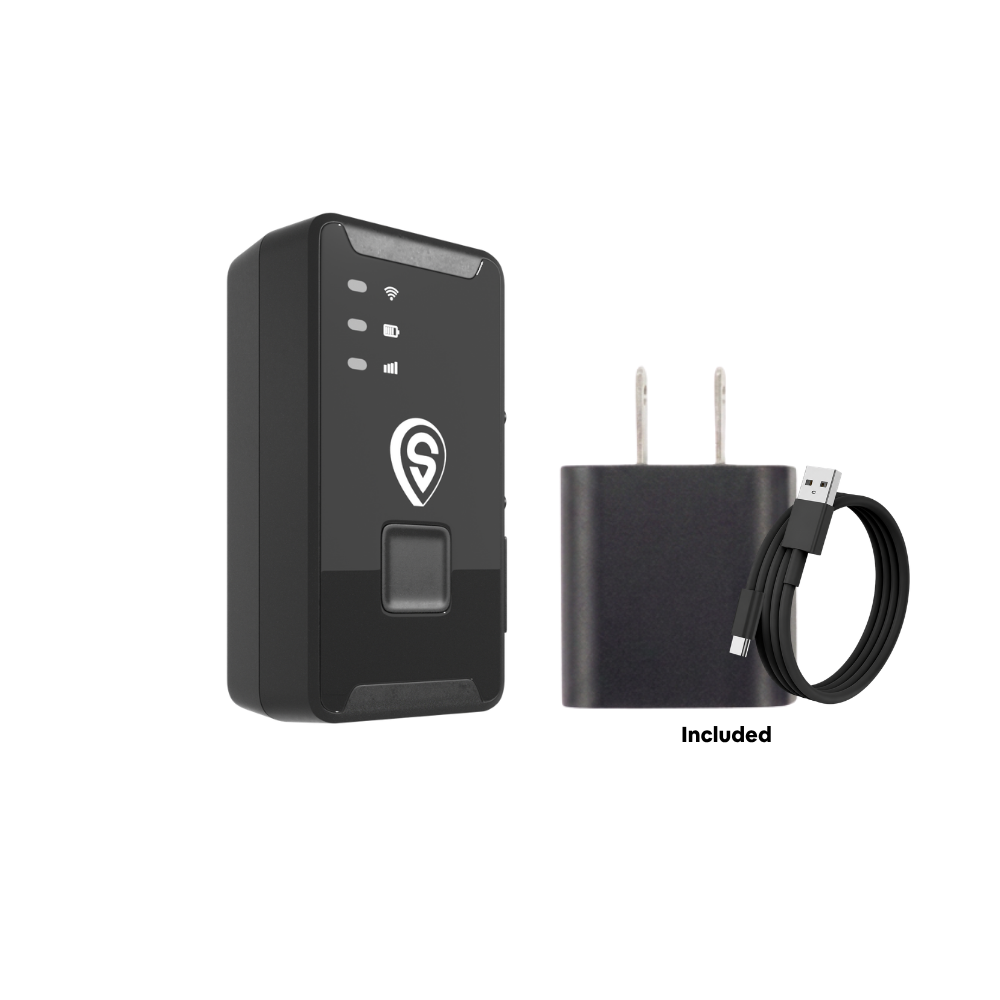
ShadowTrack
- Updates every 5 seconds while moving
- Weatherproof, magnetic mount
- Up to ~15 days per charge
 Buy Now on Amazon
Best for: trailer owners who want the fastest possible alert the moment something moves, and don't mind a quick recharge every couple of weeks.
2. PIRITIZ: Best for Long-Term Unpowered Storage
PIRITIZ takes the opposite approach from a fast-refresh tracker: instead of chasing speed, it's designed to disappear into a trailer for years. The device runs on a single internal battery rated for up to 5 years, mounts with no wiring or tools at all, and updates location based on movement rather than a constant live feed.
That tradeoff makes sense for a trailer that sits idle most of the year, a landscape trailer, a rarely used utility trailer, or a horse trailer between show seasons, where a 5-year battery outlasts the need to think about it at all. Subscription plans start at $9.95 a month with no contract.
Pros
- Up to 5-year battery life
- No wiring, mounts in minutes
- Plans start at $9.95/month, no contract
Cons
- Passive, movement-based updates instead of a continuous live feed
- Slower to flag a moving trailer than a live-refresh tracker

Best for: trailers that sit stored or idle for long stretches and need a tracker you can mount once and forget.
3. Trackhawk TH07: Best for Longest Battery Life
Trackhawk's TH07 pushes battery life even further, rated for 7+ years, inside an IP68-rated case built for heavy-duty trailers, RVs, and non-powered equipment. Its live tracking mode can update as fast as every 5 seconds while the trailer is moving, then throttles back to roughly every 6 hours once it's parked, which is how it stretches a battery that far.
Subscriptions run $22 a month or $216 a year, with business discounts available for owners running more than one trailer, one of the clearer benefits for multi-trailer operations.
Pros
- 7+ year rated battery life
- IP68 waterproof, built for heavy-duty use
- Business discounts for multi-trailer owners
Cons
- $22/month runs higher than most trailer-specific trackers here
- Parked updates slow to roughly every 6 hours to preserve battery

Best for: heavy-duty cargo or equipment trailers that need years of coverage without a recharge, where a 6-hour parked update is an acceptable tradeoff.
4. LandAirSea: Best for Real-Time Refresh & Heritage Brand
LandAirSea has built trackers for trailers, boats, and equipment for years, and its 54 model leans on that history: a compact, IP67 waterproof, magnet-mount device with plans that update as fast as every 3 seconds. Its Energy Saver mode stretches battery life up to 12 months by trading speed for longer intervals between updates, useful for a trailer parked for a season.
Plans start at $9.95 a month with month-to-month billing and no contract required; you can also prepay for 6 months, 1 year, or 2 years to lock in a lower rate.
Pros
- Refresh as fast as every 3 seconds on top-tier plans
- Energy Saver mode extends battery life up to 12 months
- Month-to-month, no contract, plus prepay discounts
Cons
- Base plan updates only every 3 minutes; fast refresh costs more
- Some reported complaints about surprise monthly fees

Best for: owners who want a well-known, USA-based brand and flexible prepay options.
Trailer GPS Tracker Comparison Table
| Tracker | Best For | Battery Life | Refresh Rate | Monthly Fee | Contract | Waterproofing |
|---|---|---|---|---|---|---|
| ShadowGPS ShadowTrack | Fastest alerts, any trailer type | ~15 days/charge | 5 sec (moving) | $10-$13/mo with 4+ devices | None, ever | Weatherproof |
| PIRITIZ | Long-term unpowered storage | Up to 5 years | Movement-based | From $9.95/mo | None | Weatherproof |
| Trackhawk TH07 | Longest battery, heavy-duty | 7+ years | 5 sec (moving) / 6 hr (parked) | $22/mo or $216/yr | None | IP68 |
| LandAirSea 54 | Real-time refresh, heritage brand | Up to 12 months (Energy Saver) | 3 sec–3 min by plan | $9.95–$49.95/mo | None (prepay discounts) | IP67 |
Battery, Wired, or Solar: Choosing the Right Power Type for Your Trailer
Every trailer tracker on the market solves the power problem one of three ways, and picking the right one depends entirely on how your trailer is actually used.
Battery-Powered Trackers
These are the right call for most personal trailers. There's no wiring and no electrician, just a magnet-mount tracker you place yourself. The tradeoff is that it may need periodic recharging, or on long-life models, a battery swap every several years, since the battery is the only thing keeping it running.
Hardwired Trackers
A hardwired tracker draws continuous power once it's connected to a live electrical source, which means no charging cycle to manage. The catch is that your trailer needs an existing 12-24V electrical hookup to tap into, and the tracker still goes dark the moment that connection is cut, exactly when a trailer is most likely to be stolen.
Solar-Powered Trackers
A solar panel that keeps a battery topped off is a strong fit for a trailer parked outdoors for long periods with regular sun exposure, a boat trailer at a marina or a flatbed sitting in an open yard. It reduces how often you think about the battery, but it underperforms on a trailer stored in a garage, under a cover, or through a dark winter.
How Much Does a GPS Tracker for a Trailer Cost?
A GPS tracker for trailer use typically runs $20 to $70 for the hardware, plus a monthly fee anywhere from about $9.95 to $22, depending on how often it updates and how long the battery is rated to last. The fastest standard refresh rates, an update every 5 seconds while moving, usually land at $12 to $22 a month; slower, movement-based plans built around multi-year batteries can start under $10 a month.
The number worth checking isn't the sticker price, it's whether it's tied to a contract. ShadowTrack runs $12–$15/month for 5-second tracking, after a 14-day free trial, with no contract, ever, month-to-month, or prepay and save.
Geofencing & Movement Alerts: The Feature That Actually Stops Trailer Theft
Cargo and trailer theft is a genuinely large and growing problem. Verisk CargoNet, which tracks reported cargo theft nationwide, found losses reached roughly $725 million in 2025, up 60% from the year before, with the average theft now valued at nearly $274,000. California and Texas alone accounted for more than half of all reported incidents. That's commercial freight, not personal trailers, but the mechanics are identical: trailers are mobile, often unattended, and easy to move once someone's backed up with a hitch, and the financial impact compounds fast once tools, gear, or other assets go missing along with it.
Personal trailers face the same risk with far less visibility. Towable travel trailers make up the large majority of the tens of thousands of RVs reported stolen each year, according to insurance industry tracking, and unlike passenger vehicles, most states don't require the kind of registration or VIN scrutiny that makes a stolen trailer easy to trace once it's re-tagged or crosses state lines.
Geofencing is the feature built to catch the moment a trailer actually leaves, empowering you to act before things go any further. Set a virtual boundary around your driveway, storage yard, or show grounds, and you get an instant alert the second the trailer crosses it, day or night. Pair that with instant movement alerts, a notification the moment the trailer starts moving at all, hitched or not, and you find out about a theft in the minutes after it happens instead of the next time you go looking for the trailer, often the difference between preventing a loss and just reporting one.
Real-time location logs matter beyond recovery, too. If a trailer is stolen and later recovered, a documented movement history helps support an insurance claim, since it shows exactly when and where the trailer left rather than asking an adjuster to take your word for it. The same location and usage history that lets you review routes and usage can also flag when a trailer's due for a maintenance check, since bearings, tires, and brakes wear on usage, not the calendar.
Frequently Asked Questions
Is there a monthly fee for a GPS tracker for a trailer?
Yes, almost every real-time or movement-alert GPS tracker for trailer use requires a monthly fee to cover the cellular connection that sends location data to your phone. With ShadowTrack, that's $12–$15/month after a 14-day free trial, no contract, ever, month-to-month, or prepay and save. A few no-subscription trackers exist, but they typically log location for later download rather than alerting you in real time.
Does a GPS tracker for a trailer need a SIM card?
No, not one you manage yourself. ShadowTrack includes built-in cellular connectivity across major U.S. networks, so there's no SIM card to buy, activate, or swap. It works as soon as you mount it.
Is it hard to set up a GPS tracker on a trailer?
No, it's an easy setup. ShadowTrack is a magnet-mount tracker you place yourself in under 2 minutes, no tools, no wiring, and no electrician. Tuck it inside a tongue box or behind a fender and it's ready.
How does the subscription work if I want to cancel?
With ShadowGPS, you can cancel any time, there's never a contract to break. Go month-to-month, or prepay for a longer stretch to save on the rate.
How fast do GPS trackers for trailers update location?
It ranges widely, from a movement-based ping every so often on long-life battery trackers, to as fast as every 3 seconds on top-tier paid plans, to just once every few hours in power-saving parked modes. ShadowTrack updates every 5 seconds while your trailer is moving, on every plan, with no speed-based upsell.
Does a trailer GPS tracker still work when the trailer is unhitched?
Yes, if it's battery-powered. A hardwired tracker loses power the moment the trailer is disconnected from a live electrical source, which is exactly when trailer theft happens most often. A battery-powered tracker like ShadowTrack keeps reporting whether the trailer is hitched, parked, or sitting in long-term storage.
What's the best GPS tracker for a horse trailer?
For horse trailers, a fast, battery-powered tracker matters more than raw battery life, since a live alert gives you the best shot at stopping a theft in progress at a show ground or rest stop. ShadowTrack's 5-second refresh and hidden magnet mount are built for exactly that; PIRITIZ or Trackhawk are worth considering instead if your horse trailer sits stored for months at a time between shows.
Is it legal to put a GPS tracker on my own trailer?
Yes. Placing a GPS tracker on a trailer you own is legal in every U.S. state, whether you're protecting a personal utility trailer, a horse trailer, or a rental you own. The legal line appears only when someone tracks a trailer or vehicle they don't own, without the owner's knowledge or consent.
Can a thief find and remove a hidden trailer tracker?
It's unlikely with a properly hidden, magnet-mount tracker tucked inside a tongue box, behind a fender, or under the frame, out of the sightlines a quick thief typically checks. Tamper alerts also notify you the moment someone attempts to disconnect or remove the device, often the first sign something's wrong.
The Verdict: Best GPS Tracker for Trailer in 2026
Trailer theft doesn't get tracked with anywhere near the visibility of car theft. Most personal trailers aren't registered the way vehicles are, and a large share of thefts against individual owners never make it into a national statistic at all. What's clear is that a trailer sitting unattended, unhitched, and unpowered is exactly the kind of target that's hardest to protect with a lock alone.
For most cargo, utility, and horse trailer owners, that gap is closed by a battery-powered tracker with no wiring required. ShadowTrack fits owners who want the fastest possible alert the moment a trailer moves. PIRITIZ or Trackhawk are the better call if your trailer sits stored for months and you'd rather not think about a recharge. LandAirSea is worth a look if you want the fastest refresh its top tier offers and don't mind paying for it.
A tracker won't replace common sense or a good lock, but it can ensure that if your trailer or the assets inside it ever do go missing, you're not left guessing, real peace of mind for the price of a monthly fee.
Either way: mount it, see it move, cancel any time.
Know where it is. Every 5 seconds.
Mount it, see it move, cancel any time. No contract, ever.
This guide reflects pricing, specifications, and legal information published as of August 2026. Subscription pricing and features are subject to change by each manufacturer; confirm current plan pricing before purchasing. Amazon links are affiliate links; ShadowGPS may earn a commission at no extra cost to you. Cargo theft figures are from Verisk CargoNet's reported 2025 data; battery life and refresh rates vary with settings, temperature, and signal conditions.

