

You packed the backpack, checked the lunch, and watched the bus pull away, and now it's just a dot on a map you're hoping stays where it's supposed to. Backpacks get left on buses, forgotten at practice, and swapped by accident at pickup more often than most parents expect.
A GPS tracker for backpack use gives you a way to check on the bag itself instead of relying on your child to remember it, or a school office to answer the phone fast enough. The right pick depends less on brand names and more on how the tracker actually finds a location: Bluetooth, cellular, or both.
This guide breaks down every real option, from a $29 AirTag to dedicated kid-safety trackers to a real-time cellular tracker like ShadowGPS's ShadowTrack, so you can match the tech to how your child actually gets to and from school.
For most families, an Apple AirTag or Jiobit is the best GPS tracker for a backpack. AirTag is the cheapest and works well anywhere iPhones are common, like a school hallway or a city bus. Jiobit and Family1st cost more but use their own cellular connection, so they still report a location on quiet routes with few nearby phones. If you want true real-time, every-few-seconds tracking that doesn't depend on strangers' phones at all, ShadowGPS's ShadowTrack is the cellular option, best suited to a teen's larger backpack or gear bag rather than a small elementary tote.
Bluetooth tag vs. cellular tracker: the one decision that actually matters
Every "best GPS tracker for backpack" list gets confusing because it mixes two completely different technologies under one label. Sorting this out first will save you from buying the wrong thing twice.
Bluetooth tags
AirTag, Tile, and Samsung SmartTag ping nearby phones on a crowdsourced network. Cheap, tiny, and long battery life, but silent in low-phone-traffic spots like a quiet trail or rural bus stop.
Cellular trackers
Jiobit, Family1st, AngelSense, and ShadowGPS's ShadowTrack use their own SIM to report location, independent of nearby phones. More reliable coverage, but bigger, heavier, and billed monthly.
Hybrid trackers
A small number of devices blend Bluetooth, Wi-Fi, and cellular to balance battery life against coverage. Jiobit is the best-known example built specifically for kids.
A backpack tracker only has one job: report a location you can trust when it actually matters. That's a Bluetooth tag on a school bus that's packed with iPhones every morning, and it's a cellular device on a rural route or a campus where phone density is thin.
Best GPS trackers for backpacks and school bags in 2026
These picks are ranked by how well they fit inside a backpack, how reliably they report a location without relying on luck, and what they actually cost to run for a school year.
1. ShadowGPS ShadowTrack
ShadowTrack isn't built as a kid-tracker, and we won't pretend otherwise. It's a rechargeable, battery-powered cellular tracker built for trailers, equipment, and vehicles that don't have an OBD-II port. But that same design, its own cellular connection and a location that updates every 5 seconds while moving, makes it a legitimate option for a bigger backpack, hockey bag, or gear duffel where size isn't the constraint and a dependable real-time location is.
Think teen backpacks, marching band gear, travel sports bags, or a school bag that also functions as an overnight bag for divorced or co-parenting households tracking custody handoffs. For a small elementary tote, a purpose-built tracker like Jiobit or an AirTag will fit better and cost less to run.
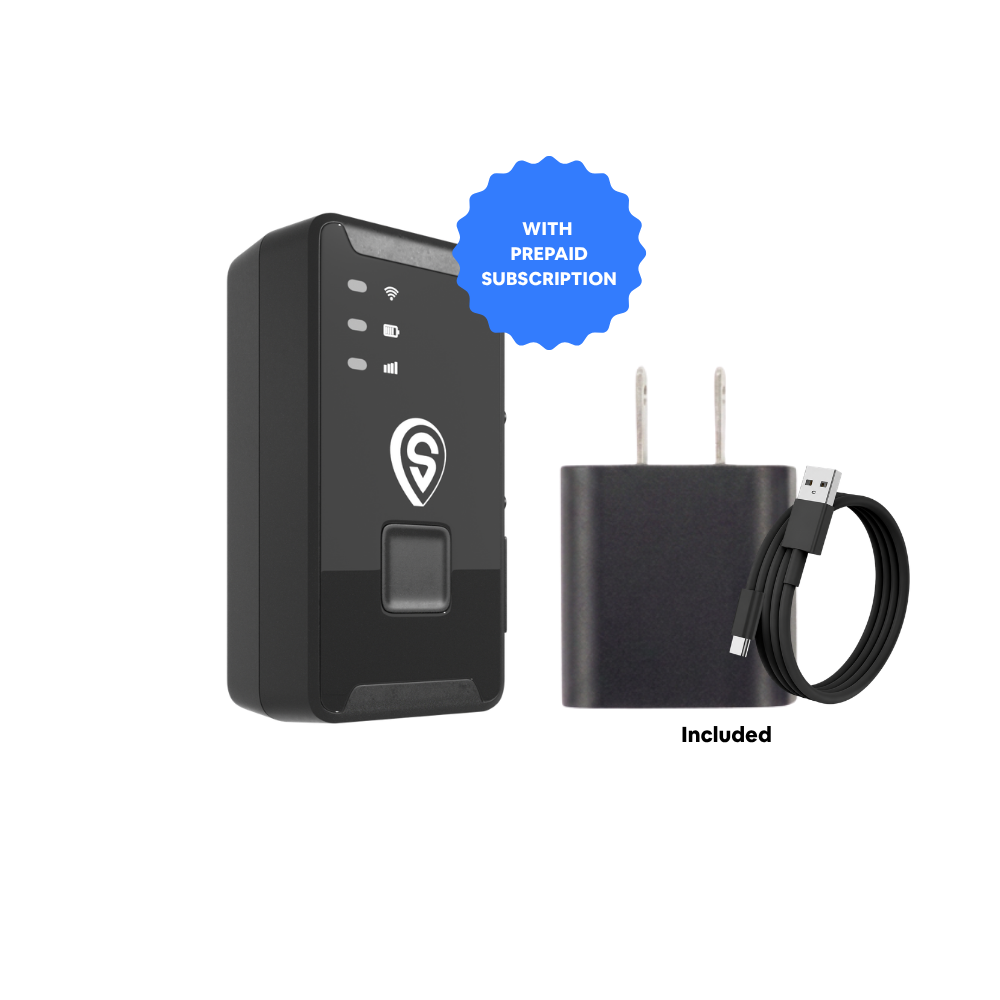
ShadowTrack
- Updates every 5 seconds while moving, no phone network needed
- Weatherproof, up to ~15 days per charge
- Trip timeline, geofence alerts, and location sharing in the app

Best for: older kids and teens with a larger bag, or anyone who wants their backpack tracker to work exactly like the tracker already on the family car.
2. Apple AirTag
The AirTag is the default answer for a reason: it's a one-time $29 purchase, it lasts about a year on a single coin battery, and it rides Apple's Find My network, which means practically any nearby iPhone can silently relay its location back to you.
Drop one into a zipper pocket and it works everywhere your child's route already has iPhone traffic: hallways, buses, parking lots, sidewalks near other parents. The tradeoff is real: no live GPS signal of its own, no SOS button, and updates can lag on quiet streets where few iPhones pass by.
Pros
- One-time cost, no monthly fee
- About a year of battery life
- Coin-sized, disappears into any pocket
Cons
- No real-time GPS, no SOS button
- Needs an iPhone in the family to set up
- Goes quiet on routes with few nearby iPhones


Best for: iPhone families with a school-day route (bus, hallway, sidewalk) that already has plenty of nearby iPhones.
3. Jiobit
Jiobit was built specifically to track kids, not objects, and it shows. It blends Bluetooth, Wi-Fi, and its own cellular connection to report a location even when no other phones are nearby, and it clips onto a backpack strap, belt loop, or shoelace without looking like a tracking device.
The catch is cost and availability. Jiobit runs a monthly plan on top of the hardware, and as of 2026 new units have been intermittently out of stock since Life360 (its parent company) shifted focus, so existing owners are served but new buyers should check current stock before counting on it.

Pros
- Works without nearby phones, unlike AirTag
- Small and discreet, made for kids
- Works with both iPhone and Android
Cons
- Monthly fee, roughly $8 to $17 depending on plan
- New hardware availability has been inconsistent in 2026
- U.S.-only cellular network, not for travel abroad
Best for: Android families, or anyone who wants a location that doesn't depend on other people's phones being nearby.
4. Family1st Portable GPS Tracker
Family1st runs its own cellular connection and updates on a set interval regardless of who's walking by, which makes it a solid pick for a backpack that travels routes with real gaps in phone coverage, like a rural bus line or a walk through a park.
It's bulkier than a Bluetooth tag and carries a monthly subscription, but the tradeoff buys a location you can actually count on instead of one that depends on luck.

Best for: routes with real gaps in phone density, where a Bluetooth tag would go quiet for long stretches.
5. Samsung SmartTag2
SmartTag2 is the Android answer to AirTag: it rides Samsung's SmartThings Find network the same way AirTag rides Apple's, so it works well anywhere Galaxy phones are common. It's a fair pick for a family without an iPhone in the house.

Pros
- No monthly fee
- Long battery life, water-resistant build
Cons
- Only reliable where Galaxy phones are common nearby
- No live GPS of its own
Best for: Android/Galaxy households that want an AirTag-equivalent without switching phones.
6. AngelSense
AngelSense is built for children who may wander or elope, including many kids with autism, and it's the most feature-rich option on this list: two-way audio, removal alerts if the device is taken off or out of the bag, and a school-day mode. It's the most expensive tracker here, both in hardware and monthly cost, but for a child who needs closer monitoring than a location dot on a map, the extra features are the point.

Best for: families managing wandering or elopement risk who need more than a location, like removal alerts and listen-in.
How they compare side by side
| Tracker | Connection | Battery Life | Monthly Fee | Fits a small backpack | Best For |
|---|---|---|---|---|---|
| Apple AirTag | Bluetooth (Find My) | ~1 year | None | Yes | iPhone families, high phone-traffic routes |
| Jiobit | Bluetooth + Wi-Fi + cellular | Several days | $8–$17 | Yes | Any phone OS, low phone-traffic routes |
| Family1st | Cellular | Days, varies by update rate | ~$20–$25 | Yes | Rural or low-coverage routes |
| Samsung SmartTag2 | Bluetooth (SmartThings Find) | Long (replaceable battery) | None | Yes | Android/Galaxy households |
| AngelSense | Cellular | ~1 day, daily charging | $30–$40 | Yes | Wandering/elopement risk, autism-specific features |
| Tile | Bluetooth | ~1 year (Mate/Pro) | None (Premium plan optional) | Yes | Budget Bluetooth option, works with Android and iPhone |
| ShadowGPS ShadowTrack | Cellular | ~15 days per charge | From $12 | Better for larger bags | Teens' bigger backpacks, gear bags, real-time tracking without nearby phones |
How to actually choose, in three questions
What phone does the family use, iPhone or Android?
This decides whether AirTag or SmartTag2 will even work at full strength, since both rely on their maker's phone network to relay a location. If the family is mixed, or the route runs through areas with few phones nearby, skip straight to a cellular tracker.
Does the route have real gaps in phone coverage?
A downtown sidewalk or a packed school bus has plenty of nearby phones for a Bluetooth tag to ping off. A rural bus route, a quiet trail, or a large campus parking lot might not. If you're not sure, a cellular tracker removes the guesswork entirely.
Is this about a location check, or a safety concern?
If you mainly want to confirm the backpack made it to school and back, a Bluetooth tag is plenty. If you're managing a wandering risk, a young child on public transit alone, or need alerts the moment the bag leaves a set zone, step up to a dedicated cellular or kid-safety tracker.
Setting up a backpack tracker without turning it into a fight
Kids notice new things in their bag, and tracking works better when it isn't a secret. A few habits make the difference:
Talk about it first
Explain why you're adding it, the same way you'd explain a phone check-in rule. Kids who understand the reason tend not to fight the device.
Set 2 to 3 zones, not ten
Home, school, and maybe a grandparent's house. Too many geofence alerts trains you to ignore all of them, including the one that matters.
Check the charge weekly
A cellular tracker with a dead battery is just extra weight. Pick a day, like Sunday night, to top it off along with backpack cleanout.
Frequently asked questions
Can you put a GPS tracker in a backpack?
Yes. Most backpack trackers are small enough to slide into an interior zip pocket, and several, like AirTag and Jiobit, are specifically sized and marketed for exactly this. The main decision is Bluetooth versus cellular, not whether it will physically fit.
What is the best GPS tracker for a kid's backpack?
For most families, an Apple AirTag (iPhone) or Samsung SmartTag2 (Android) covers routine school routes at low cost. Families who need coverage where phones aren't nearby, or safety features beyond a location dot, are usually better served by Jiobit, Family1st, or AngelSense.
Do GPS trackers for backpacks need a monthly fee?
Bluetooth trackers like AirTag, Tile, and Samsung SmartTag2 have no required monthly fee. Cellular trackers, including Jiobit, Family1st, AngelSense, and ShadowGPS's ShadowTrack, run on a monthly plan because they use their own SIM connection instead of nearby phones.
Is an AirTag good enough for a school backpack?
For most school routes, yes. Buses, hallways, and neighborhood sidewalks all tend to have enough nearby iPhones for Find My to relay a location within minutes. It's a weaker fit for rural routes, large campuses, or moments when a fast, exact location genuinely matters, since AirTag has no live GPS or SOS button.
Do backpack trackers work without Wi-Fi or Bluetooth nearby?
Only cellular trackers can. Bluetooth tags need a compatible phone nearby to relay a signal, so they go quiet in low-phone-traffic spots. A cellular device like Family1st, Jiobit, or ShadowTrack reports its own location on a set schedule, independent of what's around it.
How long does a backpack GPS tracker's battery last?
Bluetooth tags last the longest, roughly a year on a single coin cell for AirTag and Tile, since they aren't running a constant cellular radio. Cellular trackers trade that off for reliability: Jiobit and Family1st typically need a charge every few days, while ShadowGPS's ShadowTrack runs about 15 days per charge, and AngelSense usually needs daily charging.
Is it legal to put a GPS tracker in my child's backpack?
In the United States, parents and legal guardians can generally track their own minor child's belongings without legal issue, since it's the parent's property and the parent's parental authority in question. Laws vary by state and change over time, so if you have specific concerns, especially around custody arrangements, it's worth a quick check with a local attorney rather than relying on a blog post.
Already tracking the car? Track the bag too.
ShadowTrack updates every 5 seconds while moving, on its own cellular connection, no nearby phones required. Plug it in, see it move, cancel any time.
Prices, subscription plans, and specifications reflect information published as of September 2026 and are subject to change by each manufacturer. Jiobit hardware availability has been inconsistent in 2026; check current stock before purchasing. This guide is general information, not legal advice.

