Ask anyone who owns good camera gear what they want from a tracker, and the answer is rarely "a security system." It's simpler than that. They want to stop wondering whether the bag is still in the trunk, whether the laptop made it off the plane, or whether the lens case left the venue with the right person.
A GPS tracker for camera equipment gives you that answer on your phone. Drop one into your camera bag, laptop backpack or hard case, and you can see where it is right now, get an alert the moment it moves when it shouldn't, and hand police a live location if it ever walks off. Below, we cover how gear trackers actually work (real GPS vs. AirTag-style Bluetooth tags), the best options for 2026, where to hide one, and a simple framework for protecting a kit that can be worth more than a used car.
The best GPS tracker for camera equipment is a small cellular GPS tracker with motion alerts, like ShadowTrack, tucked inside your camera bag or case. It shows live location anywhere with cell coverage and alerts you the moment your gear moves. Add a Bluetooth tag (AirTag, Tile or SmartTag) as a second layer, but remember that Bluetooth tags only update when a compatible phone passes nearby. They are finders, not live trackers.
ShadowTrack: live GPS for your camera bag, laptop backpack or gear case
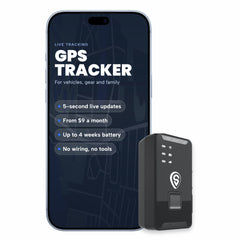
ShadowTrack is our own battery-powered GPS tracker, and gear like this is exactly what it's built for: things you care about that don't have a power cable or an OBD port. At 3.07 x 1.57 x 1.05 inches, it's a little smaller than a deck of cards, so it slides into a padded lens divider, a laptop-sleeve pocket or the foam of a hard case.
While your bag is moving, its location refreshes every 5 seconds in the ShadowGPS app, so you watch it travel instead of guessing where it was last seen. Setup takes under 2 minutes: charge it, switch it on, drop it in the bag. From then on you get motion, geofence and tamper alerts on your phone, a full year of trip history with trip replay, and Share Location if you ever need to send a live link to police or a teammate. One charge lasts up to about two weeks depending on how much it moves, and you can choose how often it reports to stretch that further.
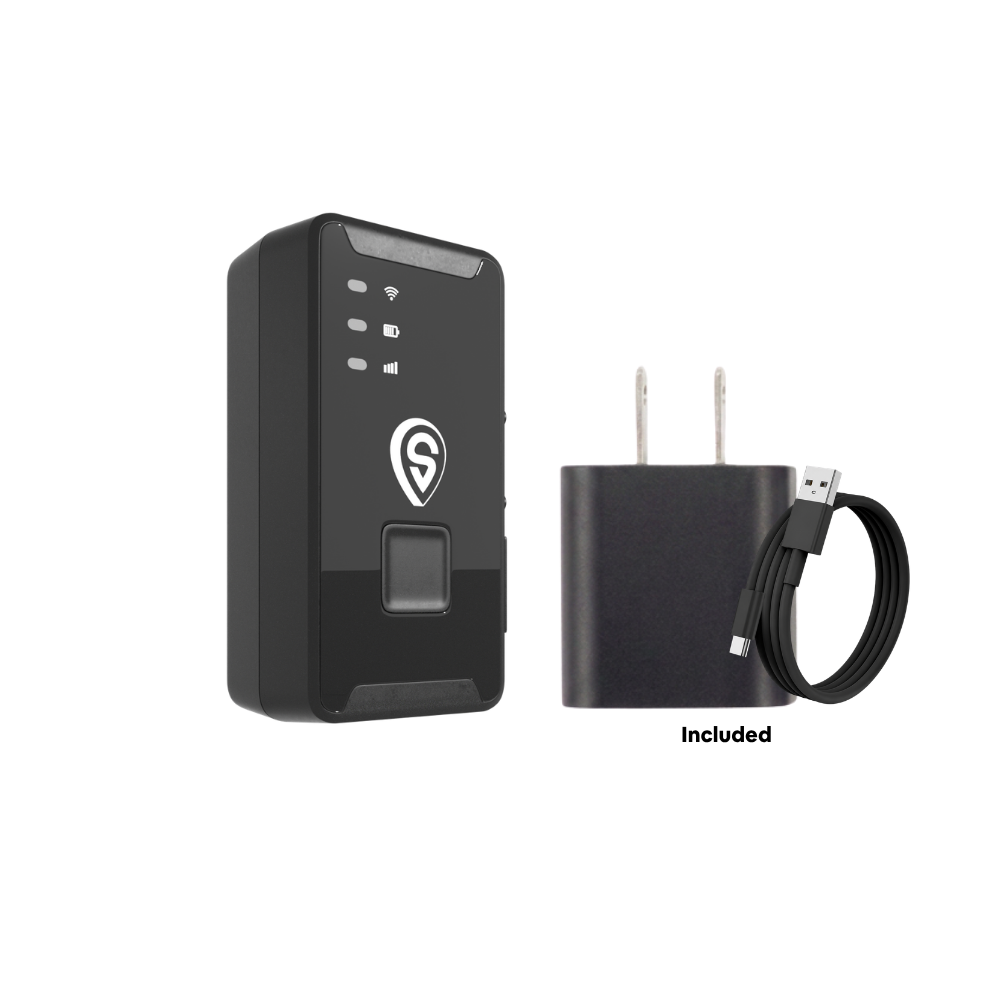
ShadowTrack
- Live location in the app whenever your gear moves
- Motion, geofence and tamper alerts on your phone
- 1-year trip history, trip replay and Share Location

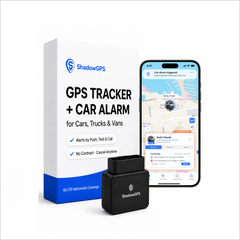
Here's the part most camera-gear guides skip: a lot of gear goes missing from cars. Theft from vehicles is one of the most common property crimes in the U.S. (numbers below), and your camera bag usually rides in the same car or truck you park outside the venue, the trailhead or the hotel. If that car matters to you as much as the kit inside it, ShadowAuto plugs into the OBD-II port and keeps an eye on the car itself.
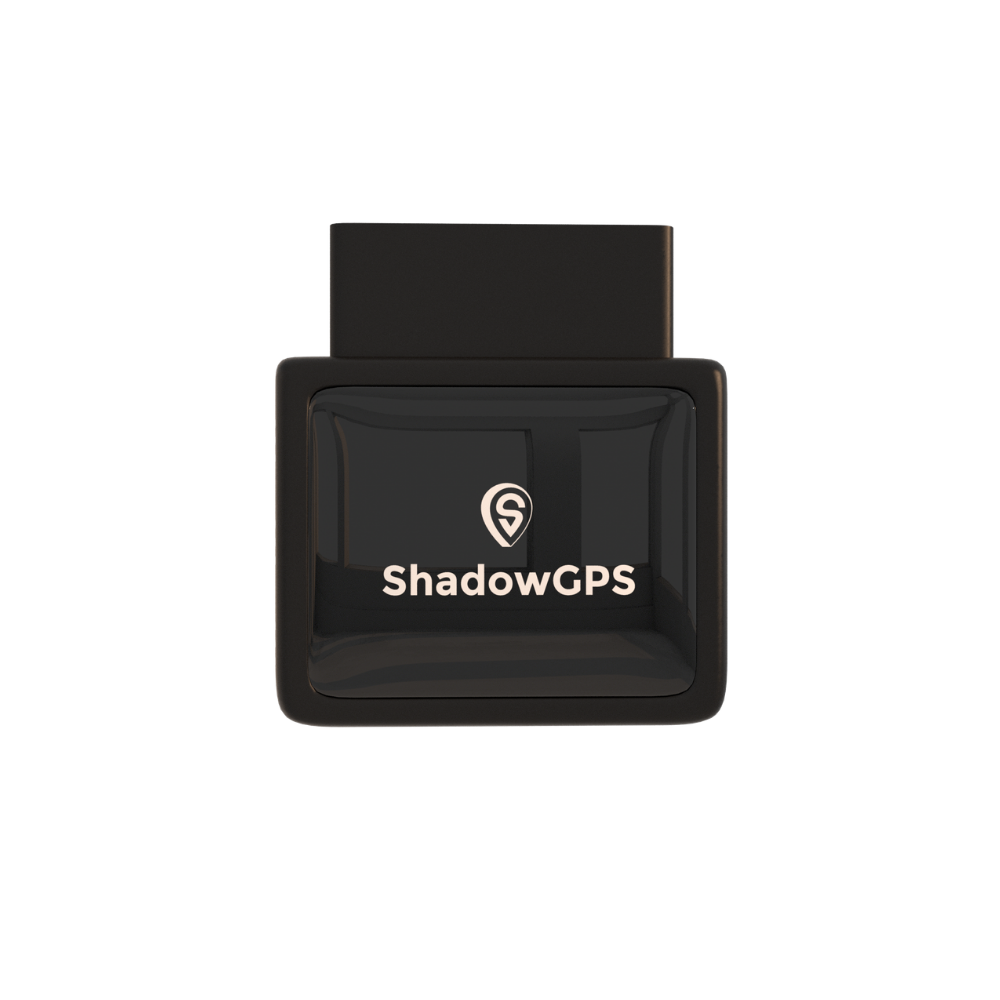
ShadowAuto
- Plugs into your OBD-II port in under 2 minutes, no tools
- Car Alarm and tamper alerts if someone messes with your car
- Live tracking, trip timeline and engine-code alerts
Best for: photographers, videographers, drone pilots, remote workers and small crews who want to see their gear move in real time, not just find out where it was last spotted.
GPS tracker for camera equipment vs. a camera GPS geotagger
Search "gps tracker for camera" and you'll see two very different products mixed together. It's worth sorting them out before you spend a dollar.
- Theft and loss trackers (what this guide covers) live in your bag or case and send their location to your phone. They answer one question: where is my gear right now?
- Geotagging receivers, like hotshoe GPS units and GPS data loggers (Canon's GP-E2 or Sony's older GPS-CS1KA, for example), write coordinates into each photo's EXIF metadata. They tell you where a photo was taken. They don't report to your phone and won't help you recover a stolen camera.
If you want both, use both. Let your camera or phone handle geotagging, and let a dedicated tracker handle security. One device rarely does both jobs well.
How gear trackers work: GPS vs. Bluetooth vs. built-in Find My
Every "camera tracker" on the market falls into one of three groups. The differences decide whether you'll see your bag move live or find out where it was hours ago.
Cellular GPS trackers
A cellular GPS tracker figures out its own position from GPS satellites, then sends that location over a cellular network (ShadowTrack uses multi-carrier LTE-M) to an app on your phone. Because it doesn't depend on strangers' phones, it reports from a quiet parking lot or a rural highway just as well as a busy airport, as long as there's cell coverage.
The trade-offs: it needs recharging every week or two, and the data connection carries a monthly fee. For theft recovery, though, nothing else gives you a live, moving dot and an instant motion alert.
Bluetooth tags (AirTag, Tile, SmartTag)
Bluetooth tags don't have GPS. They broadcast a short-range signal that nearby phones in the same network pick up and relay. In a city full of iPhones, an AirTag can be found quickly. On an empty road or in a storage locker, it may go silent for hours.
There's a second catch photographers often miss. Apple and Google both alert people when an unknown tag seems to be traveling with them (Apple explains how these alerts work here). That's a good anti-stalking feature, and it also means a thief carrying your bag may get a notification pointing straight to your tag.
Built-in laptop tracking (Find My Mac, Windows Find My Device)
Laptops come with location tools, but they only work if you turned them on before the laptop went missing, and they generally need the laptop to have power and a connection. Their real strength is remote lock and erase, which protects your data. They're a must-have, not a recovery plan.
Cellular GPS tracker
Live location anywhere with cell coverage, motion and geofence alerts, trip history. Needs charging and a monthly fee. Best for theft recovery.
Bluetooth tag
Tiny, long battery, no monthly fee. Updates only when a compatible phone passes nearby. Best as a backup or for "where did I leave it?"
Built-in software
Free and already on your laptop. Needs power and a connection. Best for locking and erasing your data.
Where camera, laptop and gear theft actually happens
Most gear doesn't vanish from a locked studio. It disappears in the few minutes it's out of your hands. National crime data backs this up.
- Larceny-theft is most property crime. It made up 72.3% of U.S. property crime in 2024, according to USAFacts' analysis of FBI data.
- Cars are a top target. FBI Crime Data Explorer figures show more than 4.2 million theft-from-vehicle incidents between 2020 and 2024, the second-largest larceny category after the catch-all "all other" group.
- There's good news, too. Reported larcenies from vehicles dropped below one million in 2024 for the first time in years, as awareness and prevention tools spread.
- Gear loss dwarfs the average theft. The FBI's last published average for a larceny was $1,162 per offense (2019). A single pro lens can cost more than that, and a working camera kit can run well into five figures.
Parked cars and trucks
A camera bag on the back seat during a dinner stop, a laptop in the trunk at the gym, a drone case in the truck bed at a job site.
Travel and hotels
Checked bags that miss a connection, rideshare trunks, hotel luggage rooms and coffee-shop tables.
Shoots, venues and job sites
Weddings, events and sets where cases sit by the door, plus shared studios and gear rooms.
Notice the pattern: gear goes missing when it's briefly unattended. That's exactly the window a motion alert covers.
How we chose the best GPS trackers for camera gear
We design, ship and support GPS trackers every day, so we know where they shine and where they fall short. We judged every option against what actually matters when a camera bag or laptop goes missing, and we've included competitors wherever they're honestly the better fit for a specific job.
Best GPS trackers for camera equipment and high-value gear (2026)
ShadowTrack is our pick for live tracking (above). These are the best alternatives and add-ons, from Bluetooth backups to other cellular trackers.
1. Apple AirTag 2
Apple's second-generation AirTag keeps the same $29 list price as the original and finds items from farther away, including from an Apple Watch. It taps Apple's enormous Find My network, and Precision Finding uses ultra-wideband to point you to the last few feet.
It's a superb way to find a bag you left behind. It is not a live tracker: it reports only when an Apple device passes nearby, and the anti-stalking alerts mentioned above can tip off a thief. Use it as a second layer next to a GPS tracker, not instead of one.
Pros
- Huge Find My network in cities and airports
- Tiny disc fits any pocket or strap mount
- No monthly fee, about a year per coin battery
Cons
- iPhone only
- No live tracking or motion alerts
- Unknown-tag alerts can lead a thief to it


Best for: iPhone users who want a low-maintenance backup tag in a camera bag or checked luggage.
2. Tile Pro
Tile Pro works with both iPhone and Android, which makes it the easy choice for households or crews on mixed phones. It has one of the longest Bluetooth ranges in its class, a loud ring and a replaceable battery.
Its finding network, now part of Life360, is smaller than Apple's, and some advanced alerts need a Life360 membership. Treat it like an AirTag: great for misplaced gear, limited for theft.
Pros
- Works with iPhone and Android
- Long Bluetooth range and loud ring
- Replaceable battery
Cons
- Smaller finding network than Apple or Google
- No live tracking
- Some alerts need a paid membership

Best for: Android shooters and mixed-phone teams who want one tag that works for everyone.
3. Samsung Galaxy SmartTag2
If you shoot on a Galaxy phone, SmartTag2 plugs straight into Samsung's SmartThings Find network, with a lost mode, water resistance and long battery life. Supported Galaxy phones also get ultra-wideband guidance to the tag.
Like other Bluetooth tags, it depends on nearby devices and won't give you a live, moving location.
Pros
- Built into Galaxy phones, no extra app
- Water resistant and long battery life
- Lost mode with contact info
Cons
- Galaxy phones only
- No live tracking
- Weak in remote areas

Best for: Samsung users who want a backup tag that works natively with their phone.
4. Chipolo CARD
Chipolo CARD is shaped like a credit card, so it slips into a laptop sleeve, passport wallet or the flat pocket of a camera backpack where a round tag would bulge. It comes in versions for Apple Find My and for Android's Find Hub.
It's still Bluetooth only, so it's best for finding a sleeve you left at a café, not tracking a stolen laptop across town.
Pros
- Credit-card thin, disappears in a sleeve
- Versions for iPhone and Android networks
- No monthly fee
Cons
- No live tracking
- Pick the right version for your phone
- Bluetooth range limits in remote areas

Best for: laptop sleeves, document folders and flat backpack pockets.
5. LandAirSea 54
LandAirSea 54 is one of the best-known cellular GPS trackers on Amazon, with 4G LTE coverage, a strong built-in magnet and a waterproof shell. Its own blog pitches it for camera bags, and it does give true live tracking.
Its design leans toward vehicles (the magnet is the headline feature), and service plans and update speeds vary by plan, so compare the plan you'll actually use.
Pros
- True cellular GPS with live tracking
- Waterproof with a strong magnet
- Large base of reviews
Cons
- Service plan required
- Update speed depends on plan
- Built more for vehicles than bags

Best for: people who mainly want a magnetic vehicle tracker that can also ride in a gear case.
6. Tracki
Tracki is a small cellular GPS tracker that pairs 4G LTE with Wi-Fi positioning and advertises global coverage, which makes it a reasonable option for international shoots.
As with any cellular tracker, battery life drops fast at frequent update settings, and a service plan is required. Check what's included before you travel.
Pros
- Live GPS tracking
- Wi-Fi assist for indoor locations
- Global coverage options
Cons
- Service plan required
- Battery drains quickly at fast settings
- App experience gets mixed reviews

Best for: photographers who travel internationally and want live tracking abroad.
GPS tracker for camera gear comparison table
Here's how the options stack up on the features that decide whether you can actually get your gear back.
| Tracker | Type | Live tracking | Works away from phones | Motion alerts | Power | Best for |
|---|---|---|---|---|---|---|
| Apple AirTag 2 | Bluetooth / UWB | No | No | No (separation alerts only) | Coin cell, about 1 year | iPhone backup tag |
| Tile Pro | Bluetooth | No | No | No | Replaceable battery | Android or mixed homes |
| Samsung Galaxy SmartTag2 | Bluetooth / UWB | No | No | No | Coin cell, long life | Galaxy phone owners |
| Chipolo CARD | Bluetooth | No | No | No | Card battery | Laptop sleeves |
| LandAirSea 54 | Cellular GPS | Yes | Yes | Yes | Rechargeable | Vehicle-first tracking |
| Tracki | Cellular GPS + Wi-Fi | Yes | Yes | Yes | Rechargeable | International travel |
| ShadowTrack | Cellular GPS (LTE-M) | Yes, 5-sec while moving | Yes | Yes, plus geofence and tamper | Rechargeable, up to ~2 weeks | Camera bags, laptops, gear cases |
Feature details based on each manufacturer's published specs as of November 2026. Cellular trackers require a service plan. Bluetooth tags have no monthly fee but depend on nearby phones.
How to choose a GPS tracker for camera gear: 5 questions
Answer these five questions in order and the right tracker usually picks itself.
- Do you need live tracking or just "last seen"?
- Will your gear spend time away from crowds?
- Do you want to know the moment it moves?
- Will it fit where you plan to hide it?
- What does it cost to keep running, and can you cancel?
1. Live tracking or "last seen"?
If your goal is recovering stolen gear, you want live location. A thief moves fast, and a location from two hours ago is a guess. If you mostly misplace things, a Bluetooth tag is enough.
2. Away from crowds?
Landscape shooters, drone pilots and anyone who works rural job sites should lean on cellular GPS. Bluetooth tags need passing phones, and back roads don't have many.
3. Instant motion alerts?
A motion alert turns a tracker from a map into an early warning. Set a geofence around your car, studio or hotel, and you'll know within seconds if your bag leaves without you.
4. Will it fit?
Measure the pocket you plan to use. Card-style tags suit laptop sleeves. A cellular tracker like ShadowTrack fits lens dividers, backpack linings and hard-case foam.
5. Running cost and cancellation
Cellular trackers carry a monthly fee for the data connection. Look for plain pricing with no contract and no cancellation fee, so you can pause it between seasons if your shooting schedule changes.
Where to hide a GPS tracker in your camera gear
A tracker only helps if it stays with the gear. Hide it where a thief won't look first and where it still gets a signal.
Camera bags and backpacks
Inside a padded divider
Slit the seam of a spare divider, slide the tracker in and close it with a strip of hook-and-loop. It looks like part of the bag's padding.
Behind the laptop-sleeve lining
Many camera backpacks have a zippered liner behind the laptop sleeve. It's rarely emptied, even when someone dumps the main compartment.
Hard cases (Pelican-style)
Cut a pocket in the foam
In pick-and-pluck foam, remove a small block from the base layer, set the tracker in and cover it. Thick, sealed cases can weaken GPS and cellular signal, so test it before you rely on it.
Laptops
Track the bag, protect the laptop
Put the tracker in the laptop backpack or sleeve, turn on Find My (Mac) or Find My Device (Windows), and write down the serial number. The tracker helps you find it, the software protects your data.
Drones, lighting, audio and tool cases
Lid foam or a magnetic case
Tuck the tracker into the lid foam of a drone or audio case. For metal rolling cases and tool chests, ShadowTrack's optional weatherproof magnetic case snaps on without tools.
Pro tip: do a 10-minute test
Before your next trip, put the tracker in the bag exactly where it will live, walk or drive around the block, and watch the app. If the dot follows you smoothly, you're set. If not, move it closer to the outer wall of the bag or case.
The Deter, Detect, Recover framework for high-value gear
A tracker works best as one layer of a simple plan. We call it Deter, Detect, Recover.
1. Deter
Use a plain, unbranded bag. Keep gear out of sight in your car. Don't leave cases by doors at venues.
2. Detect
Set motion and geofence alerts so you know the second your gear moves without you.
3. Recover
Share live location with police, keep serial numbers handy, and use trip history for your insurance claim.
Example scenario: the dinner stop between ceremony and reception
A wedding photographer leaves a backup body and two lenses in the trunk for a 40-minute dinner. ShadowTrack sits in a lens divider with a geofence drawn around the parking lot. If the bag leaves the lot, her phone alerts her right away. She doesn't chase anyone. She opens the app, sees the live location, and calls 911 with a moving address instead of a description.
Example scenario: a three-van video crew
A small production company runs three vans and a pile of shared cases. ShadowAuto is plugged into each van, and a ShadowTrack rides in the drone case and the main camera case. Trip history shows which van carried which case, and Share Location lets the producer send a live link to the crew at load-out. That's the 2-5 vehicle setup we see most often from small business owners.
Example scenario: the remote worker who travels
A consultant flies twice a month with a laptop and a mirrorless camera. The laptop stays in her carry-on with Find My turned on, a Bluetooth tag rides in her checked bag, and ShadowTrack lives in the camera backpack. Each tool does the job it's best at.
What to do if your camera gear or laptop is stolen
If the worst happens, move quickly but stay safe. Here's the order that works.
- Don't confront anyone. No lens is worth your safety. Let police handle recovery.
- Check the live location and take screenshots. Note the time, address and direction of travel.
- Call the police and share the location. Give them the live link (ShadowGPS Share Location works for this), your serial numbers and photos of the gear.
- Lock and erase your laptop. Use Find My or Find My Device to protect your data right away.
- Register the serials as stolen. Services like Lenstag let photographers flag stolen camera serial numbers, which helps if the gear shows up for resale.
- File your insurance claim. Include receipts, the police report number and the tracker's trip history as a timeline.
Track your own gear, the right way
Putting a GPS tracker in your own camera bag, laptop case or equipment is legal across the U.S. Using a tracker to follow another person without their consent is not, and many states treat it as stalking. Keep trackers on property you own or have the right to track.
Flying? Trackers and cameras contain lithium batteries. The FAA PackSafe guidelines explain how to carry them, and it's smart to keep battery-powered gear in your carry-on and check your airline's rules before you go.
Your gear rides in your car. Keep an eye on that, too.
Here's the honest truth for most of our customers: the camera bag is precious, but the car or truck it rides in is usually the biggest thing they own. ShadowAuto (shown above) plugs into your OBD-II port with no tools and tracks the car itself, with Car Alarm, trip timeline and trip replay in the same app as your ShadowTrack. Parents use it for teen drivers, and Turo hosts use it to keep tabs on rentals. If you're comparing car options, start with our best GPS trackers for cars guide.
FAQs: GPS trackers for cameras, laptops and gear
Is there a monthly fee for a GPS tracker for camera equipment?
For a cellular GPS tracker, yes, because the tracker uses a data connection to report live location. ShadowTrack plans run $9-$15/mo depending on how you bill, with no contract: month-to-month, or prepay and save. Bluetooth tags like AirTag have no monthly fee, but they can't show live location or send motion alerts.
Does a camera gear GPS tracker need a SIM card?
Not with ShadowTrack. Cellular service is built in and covered by your plan, so there's no SIM card to buy, insert or top up. Bluetooth tags don't use SIM cards at all because they rely on nearby phones.
Is it hard to set up a tracker in my camera bag?
No. Charge ShadowTrack, switch it on, pair it in the ShadowGPS app and drop it in your bag. It takes under 2 minutes, with no tools. For your car, ShadowAuto simply plugs into the OBD-II port.
Can I use an AirTag to track my camera gear?
Yes, as a finder. An AirTag is great for locating a bag you left behind in a busy place. For theft, it has limits: it only updates when an Apple device passes nearby, it can't send motion alerts, and unknown-tag alerts may lead a thief to it. Pair it with a cellular GPS tracker for real-time protection.
Can I put a GPS tracker inside my camera?
Most cameras have no room inside, and opening one can void the warranty. Instead, hide the tracker in the camera bag, a lens divider or hard-case foam. Some photographers also use tripod plates or lens caps built to hold a small Bluetooth tag.
Will a GPS tracker work inside a Pelican case?
Usually, yes, but thick sealed cases and metal cases can weaken GPS and cellular signal. Place the tracker near the lid or outer wall, then do a quick drive-around test and watch the app before you rely on it.
How long does a camera bag GPS tracker battery last?
ShadowTrack lasts up to about two weeks per charge depending on how much it moves, and you can choose how often it reports to stretch that. Bluetooth tags last much longer, often around a year, because they do far less.
Can police use a GPS tracker to recover stolen camera equipment?
A live location gives police something to act on, and it's far more useful than a description. Never try to recover gear yourself. Call police, share the live location (ShadowGPS Share Location sends a link), and give them your serial numbers.
Can I fly with a GPS tracker in my camera bag?
Generally, yes. Trackers and cameras use lithium batteries, so follow the FAA PackSafe guidance, keep battery-powered gear in your carry-on where possible, and check your airline's rules before you fly.
Is it legal to put a GPS tracker on my own equipment?
Yes. Tracking property you own, like your camera bag, laptop or equipment cases, is legal across the U.S. Tracking another person without consent is not. Keep trackers on your own gear.
Does Find My Mac or Windows Find My Device replace a GPS tracker?
No, but you should use them anyway. They need to be turned on in advance and generally need the laptop powered and online, so a thief can defeat them by shutting it off. Their strength is remote lock and erase. A tracker in the laptop bag covers the location side.
Know where your gear is, every time you check
Drop ShadowTrack in your bag or plug ShadowAuto into your car, watch it move in the app, and cancel any time. No contract, ever.
Pricing and specs checked November 2026. ShadowGPS plans run $9-$15/mo per tracker depending on billing term, with no contract and a 30-day money-back guarantee; see current pricing. As an Amazon Associate, ShadowGPS earns from qualifying purchases. Crime statistics come from FBI data via the sources linked above. Only track property you own or have the right to track.